
The Common Goldfish is the simplest type of goldfish familiar to everybody. Usually it is characterized by its evenly proportioned body and fins, and unlike all the other fancy goldfish, it is just plain simple with dull colors. Common goldfish are known to grow up to 25cm (about 10in) long although smaller size variants do exist. Another major characteristics often observed is the single-tailed that ends in a fork tail fin. It can be found in either red, yellow, orange or even dull silver color.


common goldfish, wakin, comet (in the following order)
Wakin and Comet Goldfish are 2 fine examples of the common goldfish. Wakin is a common breed of goldfish (double tailed and usually found in bright red color) originated from Japan while the Comet (differentiated by having forked, longer tail fin) is known to be developed by the Americans. Both types are considered to be striking variant although they are still identified to belong to the group of common goldfish. All those mentioned above are hardy and relatively easy to care for. They are also known to be an active type more suited in an outdoor fish pond.
Ranchu
The Ranchu is the Japanese variant of goldfish bred from the Lionhead. It is not difficult to characterize this particular goldfish, as it can be easily identifiable by its short, round body with thick fins. Perhaps if you observe carefully you will notice that one of the most prominent features is the lack of dorsal fin. The tail can be made up of 4 lobes and is very short in length. Ranchu rarely grows beyond 15cm measured from head to end of tail fin. Similar like its lionhead cousin, it has a hood on its head, which looks like a raspberry outgrowth protruding from the skin.

The goldfish is also known for its colorful feature and is usually found in red, orange or white striking combinations. Ranchu is a highly prized and sought after goldfish not only in Japan but also other parts of the world including America and Europe. In fact, the Japanese are so fond of it and competitions were organized during autumn each year to select the best fish. The art of judging and selecting the best Ranchu comes from the few basic concepts outlined below.
- Eyes should be evenly placed, small and protrude clearly from the headgrowth
- The stomach should form a smooth curve starting from the gill to the end of the abdomen
- When seen from above, the back of Ranchu should be broad and properly aligned with the body and finally,
- The scales must be complete and regular with no visible deformity in sight
No doubt with its elegant and unique characteristics, Ranchu has always remained to be one of the most popular goldfish. In Japan, this hobby is highly revered upon and refined to perfection. It is one of the most beautiful goldfish, which remains one of my favorite
 Fantail is basically the egg-shaped version of the common goldfish with its caudal (tail) fin slightly forked and with moderate length. It can be considered the short tail version of another variety of goldfish called veiltail whereby the caudal fin is much more prolonged and trailing. Do not mistaken the failtail as aryukin because it does not have a hump on its shoulder.
Like any other goldfish varieties, fantails are also found exist in different colors ranging from red to orange while some appear as calico speckled with grey and black color spots. It can also be metallic, nacreous and even have normal or wide telescope eyes. The main distinguishing feature is of course having the split caudal fin whereby a good specimen should have the all lobes completely separated. The prize-winning specimen is also characterized as having double anal fin, which are evenly formed and look well-balanced.
Fantails can be easily bred, as long as it has large aquarium space for normal fin development and good water quality. If properly cared for, they can live up to 10 years or more and usually achieve full-grown length size of about 6 inches long measured from the head until the end of the tail fin.
pearlscale is perhaps the most interesting and exciting goldfish that you will ever find. When I was just a little kid, my first sight instantly captured my attention to this cute goldfish, which looks almost like a golf ball (some are bigger size of course) and swims in an erratic and clumsy looking manner.
Pearlscale can be easily distinguished from other goldfish with its thick, domed scales, which look like pearls. It can be found in normal orange to red color and with or without the headgrowth. There is one particular variant that stands out above the normal pearlscales with their two bubble dome formed at their headgrowth. This fancy variant is known as Hama Nishiki. Their fins are rather short and because of that, it causes the fish to have a hard time controlling their movement especially when coupled with their round body. They can grow up to 8 inches long or more depending on the degree of attention and care given.

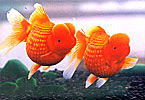
Normal Pearlscales and Hama Nishiki
Because of its physical condition, Pearlscales have a hard time swimming and competing with food with other fast swimmers. They are very susceptible to over-feeding and in fact, experienced Pearlscale breeders will tell you how hard it is to care for this fish. It is also very particular especially towards changes in water condition and will not tolerate extreme cold temperatures. Best is, water should be kept above 15degC and water changes are to be performed carefully to avoid fluctuation in parameters in order to protect this delicate goldfish. It is the hardest to maintain and cared for, however the reward and satisfaction is simply great.
Veiltail is perhaps well-known for its graceful tail and dorsal fin which looks like an angel. The long trailing beautiful fin is usually well-developed and can grow up to 6cms long depending on the age and physical condition of the Veiltail goldfish. It has a round body, the scales are metallic or nacreous and they varies in different color either in red, orange or calico. The Veiltails are known to be slow swimmers and are not supposed to be mixed with other types of active goldfish such as the Common Goldfish. This may cause them to have difficulty competing for foods.
As with other goldfish, they require moderate care and attention, and the most important aspect about this type of goldfish is to watch out for fungal growth on the long fins. As such, water must always be clean and best is, check for early sign of fungal development or sickness. Watch out also for excessive nibbing exhibited by other aggressive goldfish or tank mates as this can cause the fins to be easily damaged. If this happens, the only way to overcome the problem is segregate the fish. Today many Veiltails were cross-bred to produce different variants such as the telescope-eyed Veiltail.

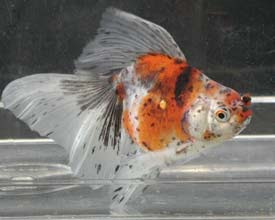
orange veiltail and calico veiltail
As with other goldfish, they require moderate care and attention, and the most important aspect about this type of goldfish is to watch out for fungal growth on the long fins. As such, water must always be clean and best is, check for early sign of fungal development or sickness. Watch out also for excessive nibbing exhibited by other aggressive goldfish or tank mates as this can cause the fins to be easily damaged. If this happens, the only way to overcome the problem is segregate the fish. Today many Veiltails were cross-bred to produce different variants such as the telescope-eyed Veiltail.
orange veiltail and calico veiltail


Shubunkin or best known as Calico Goldfish is easily recognizable by its nacreous scales (metallic and shiny transparent scales) covering its whole body with patches of red, white or silver blue on the background coupled with speckles of black spot. It has long, torpedo-shaped thick body with single tail fin and basically there are 3 different distinct variant, which can be identified by the tail fin.
(top from left to right)
The American Shubunkin has long and forked tailfins
The Bristol Shubunkin has forked tailfins but it ended in lobes
The London Shubunkin has short and round tail fin.
Shubunkin can grow quite large size reaching length of almost 12 inches measured from head to tail and it is considered a hardy variety meaning that it can tolerate moderate changes in water parameters quite well. Because of its size and active nature (fast swimmers), Shubunkin are sometimes kept in ponds together with koi where they can grow and thrive better compared to keeping them in large glass aquariums.
As with all goldfish, Shubunkin readily accepts all types of food and a very hearty diet. Because they eat a lot, usually they will discharge a lot of waste and fouls the water easily. Shubunkins are recommended to be kept with other fast swimmers like the common goldfish with water temperature maintained at about 20 – 24deg Celsius
 Black Moor is unique in the sense that it can be easily recognized by its solid black velvety color. It is sometimes referred to as the black version of the telescope goldfish because of its protruding eyes. However, it does not protrude as far compared to the other normal telescopes. The fins are generally thick and the body is very stout and deep. This variety of goldfish is considered hardy and will tolerate changes in water temperature easily as long as it is not in the extremes. Thus the goldfish is highly recommended especially for beginners.
Similar like other goldfish varieties, black moor has a very hearty appetite and will gobble up almost anything that you feed to them. They are not selective and picky when it comes to food and will readily accept fish food pellets, flakes, live foods, cucumbers and peas. However, due to their poor eyesight, they usually have difficulty finding their food and as such, they should not be mixed with other goldfish varieties that are fast and agile like common goldfish, shubunkin and fantail.
Black moor are not born black. The young moors are actually colorless and will then slowly turn into bronze before coming to their all-black velvety appearance. Most black moors will retain the color until old age while some will slowly revert to orange color as it grows old. Believe me, I’ve seen before a young black moor raised up to become an orange adult telescope goldfish and many people do not realize that this is actually true.
 Pom Pom can be easily recognized from other goldfish and unique in the sense that it has a pair of fleshy outgrowth, which is actually enlargement of the nasal septum that closely resembles, well as the name implies a pom pom. When I first saw the fish, I thought it was really strange and bizarre because it never crossed my mind that somehow those were really natural and part of the fish. Although I've never successfully bred a pom pom before, what I actually observed is that the pair of outgrowth were actually not present when the fish was young and it only started to develop as it matures.
Pom pom generally has fins similar to a fantail including body shape and if you were to take away the outgrowth, everything matches exactly like the fantail. Pompom also exist in different colors being chocolate as one of the most common of all (depicted in above pic). Others exist in either orange, white, yellow with either metallic or nacreous scales. As with other common goldfish, pom pom will tolerate living condition at the temperature around 18 to 21degC and have a hefty appetite. It is considered a fast swimmer and thus should not be mixed with other slow swimmers such as pearlscale,bubble-eye, celestial and tosakin. Since it is one of the goldfish species, if given a chance it can interbreed and the off-spring can actually appear to be normal goldfish without the nasal outgrowth.
randa is easily recognizable from its prominent hood, which looks like a lumpy growth protruding out from the skin covering the whole head except for the eyes and mouth. Depending on the nutrition you provide for the fish, the growth should start developing after 8 months of age and sometimes it can even block the eye view making the fish having poor visibility. They are very sensitive to low temperatures and usually temperature range between 18 to 22degCelcius suits best for the fish. Orandas can grow up to very large size often exceeding 7 inches in length. Therefore, care must be taken to ensure that they have enough space for the fish or else risk having stunted fish. Like any other goldfish, Orandas are very greedy and will eat just about anything but it is best that you control their diet by providing a mixture of live and dry fish food to ensure they get all the necessary nutrition.

Fine specimen of RedCap Oranda
Oranda comes in variety of colors ranging from interesting yellow to red, sometimes chocolate while there is also a white variant with a particular red cap hence the name “red cap oranda”. Though generally a hardy fish, which means it can tolerate mild changes in water conditions, care must be taken to ensure that the water is always clean by having good aquarium filters in order to prevent bacterial infections from developing in their headgrowth. Nevertheless, aquarium maintenance has to be given priority if you intend to ensure that your fish live longer to be your faithful companion.
 Ryukin is a beautiful variety of thegoldfish. It can easily be identified from other types of goldfish by its deep body and with a hump right before the head near the dorsal fin. It has long finnages similar like veiltailsand it is commonly found in red, white and orange color. Ryukin has metallic scales and the tail fin is fully forked and divided. It is considered a hardy fish, which can grow up to 8 inches long and is very popular in Japan.
 There is another Japanese variety of the Ryukin called the Tosakin that has similar characteristics except that the tail fin opens flat and wide horizontally. If you observe the fish from above, the tail actually spreads out nicely like a butterfly and the beauty is indeed magnificent. However, Tosakin is rather delicate and is very difficult to breed. It swims clumsily and generally requires extra care such as making sure the stream of water is not too turbulent or else it will jeopardize normal tail fin development. And because of its slow swimming nature, some aquarist has resorted to use hand spawning in order to successfully breed the goldfish.
Tosakin is also very sensitive to changes in water quality and some experts actually suggest using slight greenish water containing algae. In order to produce the desired butterfly tail, some aquarist has gone to the extreme by keeping the fish in a small container to limit the growth and length of the body while allowing the tail fin to develop. In Japan, Tosakin is highly prized and sought after and various competitions are organized to select the best fish.
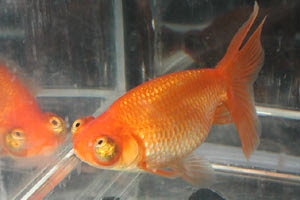 Perhaps one of the most remarkable, weirdest and astonishing goldfish varieties is the Celestial. Nobody really knows where this type of goldfish originated and whether it is actually a result of selective breeding. Celestial is very much similar in terms of finnage like the other goldfish except that it has a very large telescope eyes turning upwards and a long body. It doesn’t grow very large and another notable trademark is its lack of dorsal fin. But believe it or not, the eyes are actually normal found in the newborn fish and it only starts to turn upwards towards its maturity age at about 6-7 months.
Well, a particular question a person must be curious about this fish is that, with its set of eyes turning upwards, will it have any difficulties in navigation and moving about without bumping into objects? Well as a proud owner who once kept this goldfish as a pet, I did not observe the fish having poor sense of direction and I can tell you that it doesn’t bump into objects. In fact, it swims pretty much well-coordinated without difficulties and my hypothesis is that since they can’t rely on their eyes for navigation, they must have adjusted to the condition by making use of other senses to guide them through. However, it is advisable that in order to help counter its poor eyesight visibility, owners must ensure that Celestial should only be kept with its own kind.
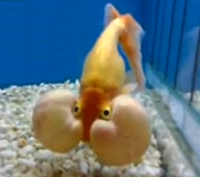 Bubble Eye Goldfish is one of the most fragile and hard to care for variety of goldfish that also fits into the exotic group along with oranda, ranchu,pearlscale, ryukin and tosakin. This unique but yet entertaining type of coldwater fish species actually look odds and clumsy in the aquarium and unlikecommon pet fish they lack a dorsal fin as well. With their blurred vision and somehow poor sense of navigation, these fish were often found stuck attached at the filter inlet causing its eye sac bubble to puncture and getting injured.
Bubble eye goldfish comes in different colors ranging from white, orange, red, calico and even black due to heavy cross-breeding. They should not be confused with another fancy goldfish variety known as the celestial which has a pair of eyes turning upwards. Young bubble eye fish usually looks pretty normal without the sac and as it grows older the bubble eye appearance will start to form and develop by the time it is about 1 year old. At first, it will look something like accumulation of fluids but as it goes on, the sac actually gets bigger and becomes more transparent.
This special type of goldfish should be kept in an aquarium large enough, and those without strong current generated by undergravel filter system or power filters. They are best housed in a tank whereby the water is calm, preferably without sharp object or any aquarium decoration that might cause injury to their eyes. Due to their delicate requirement your bubble eye goldfish should not be mixed with any other fish species, except their own kind because they will have hard time competing for foods and their eye sac will often become the target of nipping behavior exhibited by certain species especially tiger barb, swordtails and guppy.
If for any reason the eye sac becomes injured or punctured due to accidents, usually a treatment of Melafix will help but try to avoid adding any other chemicals or even salt which I believe can make things become even worse. The best solution to deal with this problem is actually to leave the eye sac to grow and heal by itself, and during this period try to ensure that the water is clean andcrystal clear so that there won’t be any chance for infection to take place that will further aggravate the injury. Depending on how serious the wound is, somehow it will take anywhere between 2 weeks or so before it gets better.
Bubble eyes goldfish nowadays are rarely sold in aquarium pet stores. Somehow due to their extreme and delicate needs, fish suppliers seem to avoid buying them and offer the fish for sale. Main reason is because if they are placed in a general tank, the owner will often overlook on certain matter and this usually results with the fish having high mortality rate and it is very normal to see them die when being neglected. Buying online is even more difficult because sellers usually will have a hard time to ensure that they will survive the trip and thus your best bet should be, if you ever come across fish farms, I would suggest you just grab the goldfish as your prized specimen.
Lionhead Goldfish is often confused and wrongly identified as a ranchu as both of them bear very close resemblance to each other. While some considered the lionhead to be less superior in every aspect in particular the shape but however it has its own special feature that makes it stand out from the rest. To make it short, Lionhead is actually bred and developed by the Chinese while the Ranchu is a Japanese variety which is line bred to select the fish with desired characteristics. What line bred means is that the baby fish or off spring will cross back to the parent fish so that the genetic trait will be retained.
Most people will not be able to tell what are the differences comparing between a normal lionhead with a ranchu but upon close observations, you can always tell them apart. The only notable characteristic that sets them different from each other is the arched back development and overall shape of the goldfish. Try to look closely and compare between the two pictures attached below and as you can see, the lionhead’s back is very much flat while the ranchu is more curved and that gives the latter a more rounded appearance. In terms of pricing and value, most people considered the ranchu's shape more pleasing towards their liking and thus, they usually command higher selling price.
 Just like the ranchu, both are also hooded fish which means that it has a type of raspberry growth on its head that looks like clumps of jelly all lumped together. Surprisingly both fishes also do not have the dorsal fin unlike the other types of goldfish. In terms of size, ranchu are known to attain bigger belly and developed much bulkier weight while observations on the tail fin will tell you that the lionhead has one which is comparatively longer. Based on these characteristics you should be able to tell them apart with the arched back appearance to support and confirmed your view. In terms of appearance, both goldfish types also have striking color combination, and they can be found in typical orange, red, white and even all black on the whole body. These days, there is also the nacreous form which is basically a variety with speckled colored scales randomly distributed and appearing against a white background. Those are my favorite as they look absolutely cute and adorable.
The lionhead is believed to bring the Chinese good luck when the aquarium which has the fish in it is placed in a strategically right position in the house. As such, it is very common to see a very large aquarium specially made dedicated to this extraordinary and unique fish. Lionhead needs a very large living space to survive and live happily. Normally the minimum tank size for them should measure at least 50 gallons in capacity whereby a normal adult lionhead will actually grow to at least 10 inches in length when proper care is given. Just like all the other fancy goldfish varieties like the celestial,tosakin and bubble-eye, they are considered delicate species which are slow swimmers and most of the time will miss grabbing their foods. This is mainly due to the hooded growth which sometimes can covers their eyes and hinder their sight. When mixed with fast swimmers like normal torpedo-shaped common goldfish and oranda they will always lose out to food competition.
Chinese lionhead is very susceptible to different kinds of disease. One particular sickness that often attack this type of fish is the fluffy white colored fungus growth which can develop on the hood and degrade the tissue on it. Without treatment, it can spread and cause the skin to be engulfed. Fish infected with the disease will often lose appetite not wanting to eat and sometimes, they can still appear in their usual mood until the condition gets worse and starts to spread. Other than this, the flipover condition is also quite common and it is often related to overfeeding and the water quality that they lives in. This is identified to be related to infection affecting their swim bladder and I did wrote an article to discuss in details on the flipover disease and I would suggest you read up about this as it is very prevalent in every type of goldfish.
Aquarium tank in which your goldfish lives in should be best left barren with clear bottom without presence of gravel. Usually just like all the other types of goldfish, they can be very clumsy in their movement and the way they swim about. Aquarium decoration which sharp edges are known to cause injuries when the fish bump into it and there are instances when they might suffer bruises and cuts due to accidental scrapping onto the surface of the object. Plants might not be suitable in a goldfish tank because they are notorious of ripping the leaves apart and eating it when they become hungry (except for when you have water sprite). As such you will need a fast growing plant to cope up with their appetite. Thus based on these facts and argument, it is a matter of sacrificing viewing pleasure without any tank decoration in exchange for the safety of your pet fish. That is for you to decide.


